Public library services for Canadians with print disabilities
  • Mobile accessibility tips
    • Change contrast
      • AYellow on black selected
      • ABlack on yellow selected
      • AWhite on black selected
      • ABlack on white selected
      • ADefault colours selected
    • Change text size
      • Text size Small selected
      • Text size Medium selected
      • Text size Large selected
      • Text size Maximum selected
    • Change font
      • Arial selected
      • Verdana selected
      • Comic Sans MS selected
    • Change text spacing
      • Narrow selected
      • Medium selected
      • Wide selected
  • Register
  • Log in
  • Français
  • Home
  • Newspapers
  • Magazines
  • Recommended
  • For libraries
  • Help
  • Skip to content
      • Change contrast
        • AYellow on black selected
        • ABlack on yellow selected
        • AWhite on black selected
        • ABlack on white selected
        • ADefault colours selected
      • Change text size
        • Text size Small selected
        • Text size Medium selected
        • Text size Large selected
        • Text size Maximum selected
      • Change font
        • Arial selected
        • Verdana selected
        • Comic Sans MS selected
      • Change text spacing
        • Narrow selected
        • Medium selected
        • Wide selected
  • Accessibility tips
CELAPublic library services for Canadians with print disabilities

Centre for Equitable Library Access
Public library service for Canadians with print disabilities

  • Register
  • Log in
  • Français
  • Home
  • Newspapers
  • Magazines
  • Recommended
  • For libraries
  • Help
  • Advanced search
  • Browse by category
  • Search tips
Breadcrumb
  1. Home

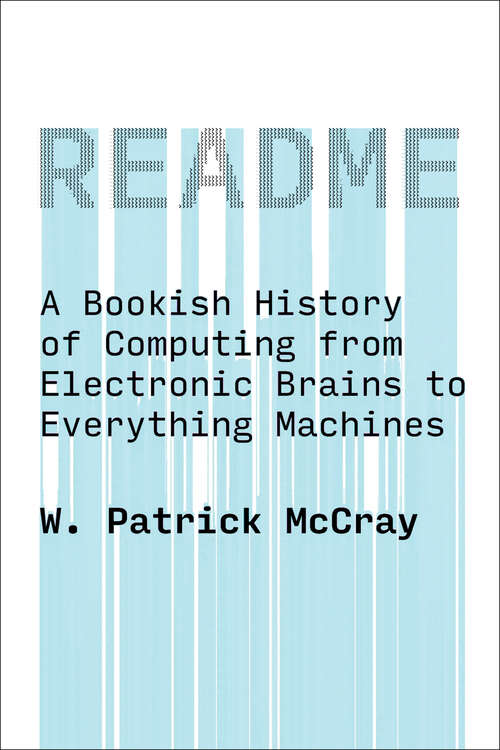
README: A Bookish History of Computing from Electronic Brains to Everything Machines

By W. Patrick Mccray

Computers and internet, Science and technology

Synthetic audio, Automated braille

Summary

The essential role that the oldest literary technology—books—played in making computers popular and pervasive.In README, historian Patrick McCray argues that in order for computers to become ubiquitous, people first had to become interested in them, learn about them, and take… the machines seriously. A powerful catalyst for this transformation was, ironically, one of the oldest information technologies we have: books. The author uses a carefully chosen selection of books, some iconic and others obscure, to describe this technological revolution as it unfolded in the half century after 1945. The book begins with a fundamental question: How does a new technology become well-known and widespread? McCray answers this by using books as a window into significant moments in the history of computing, books, publishing, and American culture.README offers a literary history of computers and, more broadly, information technologies between World War II and the dot.com crash of the early twenty-first century. From the electronic brains and cybernetics craze of the 1940s to the birth of AI, the rise of the personal computer, and the Internet-driven financial frenzy of the 1990s, books have proven a durable and essential way for people to learn how to use and think about computers. By offering a readable half-century of bookish history, README explains how computers became popular and pervasive.

Title Details

ISBN 9780262384841
Publisher MIT Press
Copyright Date 2025
Book number 6899438
Report a problem with this book

README: A Bookish History of Computing from Electronic Brains to Everything Machines

FAQ

Which devices can I use to read books and magazines from CELA?

Answer: CELA books and magazines work with many popular accessible reading devices and apps. Find out more on ourCompatible devices and formats page.

Go to Frequently Asked Questions page

About us

The Centre for Equitable Library Access, CELA, is an accessible library service, providing books and other materials to Canadians with print disabilities.

  • Learn more about CELA
  • Privacy
  • Terms of acceptable use
  • Member libraries

Follow us

Keep up with news from CELA!

  • Subscribe to our newsletters
  • Blog
  • Facebook
  • Bluesky
  • Twitter
  • Youtube

Suggestion Box

CELA welcomes all feedback and suggestions:

  • Join our Educator Advisory Group
  • Apply for our User Advisory Group
  • Suggest a title for the collection
  • Report a problem with a book

Contact Us

Email us at help@celalibrary.ca or call us at 1-855-655-2273 for support.

Go to contact page for full details

Copyright 2025 CELA. All rights reserved.