Public library services for Canadians with print disabilities
  • Mobile accessibility tips
    • Change contrast
      • AYellow on black selected
      • ABlack on yellow selected
      • AWhite on black selected
      • ABlack on white selected
      • ADefault colours selected
    • Change text size
      • Text size Small selected
      • Text size Medium selected
      • Text size Large selected
      • Text size Maximum selected
    • Change font
      • Arial selected
      • Verdana selected
      • Comic Sans MS selected
    • Change text spacing
      • Narrow selected
      • Medium selected
      • Wide selected
  • Register
  • Log in
  • Français
  • Home
  • Newspapers
  • Magazines
  • Recommended
  • For libraries
  • Help
  • Skip to content
      • Change contrast
        • AYellow on black selected
        • ABlack on yellow selected
        • AWhite on black selected
        • ABlack on white selected
        • ADefault colours selected
      • Change text size
        • Text size Small selected
        • Text size Medium selected
        • Text size Large selected
        • Text size Maximum selected
      • Change font
        • Arial selected
        • Verdana selected
        • Comic Sans MS selected
      • Change text spacing
        • Narrow selected
        • Medium selected
        • Wide selected
  • Accessibility tips
CELAPublic library services for Canadians with print disabilities

Centre for Equitable Library Access
Public library service for Canadians with print disabilities

  • Register
  • Log in
  • Français
  • Home
  • Newspapers
  • Magazines
  • Recommended
  • For libraries
  • Help
  • Advanced search
  • Browse by category
  • Search tips
Breadcrumb
  1. Home

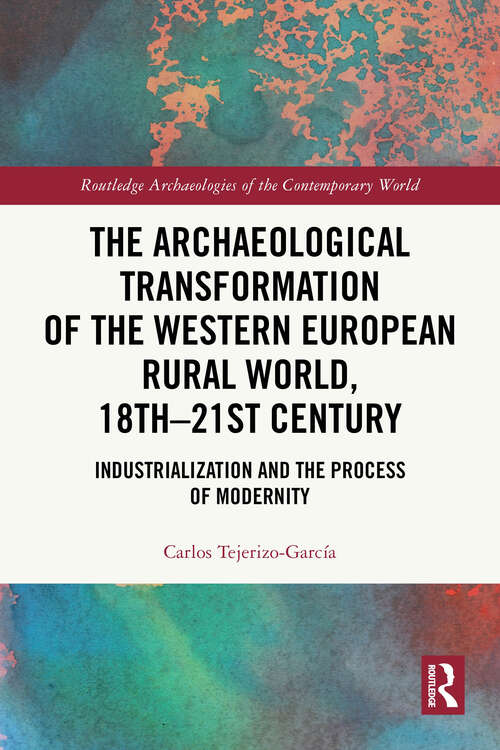
The Archaeological Transformation of the Western European Rural World, 18th-21st Century: Industrialization and the Process of Modernity (Routledge Archaeologies of the Contemporary World)

By Carlos Tejerizo-García

Archaeology

Synthetic audio, Automated braille

Summary

How the rural world in Western Europe became modern? Who were the main agents of this change? Did these transformations have an impact on the local environment? This book explores the process of transformation of Western pre-industrial rural societies into… industrialized ones through an archaeologically driven analysis based on two villages in northwestern Iberia.After a theoretical consideration of what is the process of modernity and how it can be approached, the book is organized chronologically, considering the transformations of the rural world in northwestern Iberia over time from the 18th century to the COVID-19 pandemic. Departing from a critique of the abstract and Eurocentric common approaches to modernity, this book seeks to build strong and thick narratives of the process of modernity as a historical process from a local point of view, benefiting from approaches such as microhistory and historical anthropology. Tackling the process of transformation of modern rural communities from an archaeological point of view, chapters are oriented by the analysis of different strands of material records and their changes over time, from specific materialities to archaeobotanical data and aerial photography. This book renders visible the deep roots of the transformation to industrialization that has characterized Western Europe ever since and sets forth some reflections and considerations for its future.This book is intended for researchers in the fields of historical and contemporary archaeology as well as modernity studies, industrial archaeology and history and social history.

Title Details

ISBN 9781040686836
Publisher Taylor & Francis
Copyright Date 2026
Book number 6893498
Report a problem with this book

The Archaeological Transformation of the Western European Rural World, 18th-21st Century: Industrialization and the Process of Modernity (Routledge Archaeologies of the Contemporary World)

FAQ

Which devices can I use to read books and magazines from CELA?

Answer: CELA books and magazines work with many popular accessible reading devices and apps. Find out more on ourCompatible devices and formats page.

Go to Frequently Asked Questions page

About us

The Centre for Equitable Library Access, CELA, is an accessible library service, providing books and other materials to Canadians with print disabilities.

  • Learn more about CELA
  • Privacy
  • Terms of acceptable use
  • Member libraries

Follow us

Keep up with news from CELA!

  • Subscribe to our newsletters
  • Blog
  • Facebook
  • Bluesky
  • Twitter
  • Youtube

Suggestion Box

CELA welcomes all feedback and suggestions:

  • Join our Educator Advisory Group
  • Apply for our User Advisory Group
  • Suggest a title for the collection
  • Report a problem with a book

Contact Us

Email us at help@celalibrary.ca or call us at 1-855-655-2273 for support.

Go to contact page for full details

Copyright 2025 CELA. All rights reserved.