Public library services for Canadians with print disabilities
  • Mobile accessibility tips
    • Change contrast
      • AYellow on black selected
      • ABlack on yellow selected
      • AWhite on black selected
      • ABlack on white selected
      • ADefault colours selected
    • Change text size
      • Text size Small selected
      • Text size Medium selected
      • Text size Large selected
      • Text size Maximum selected
    • Change font
      • Arial selected
      • Verdana selected
      • Comic Sans MS selected
    • Change text spacing
      • Narrow selected
      • Medium selected
      • Wide selected
  • Register
  • Log in
  • Français
  • Home
  • Newspapers
  • Magazines
  • Recommended
  • For libraries
  • Help
  • Skip to content
      • Change contrast
        • AYellow on black selected
        • ABlack on yellow selected
        • AWhite on black selected
        • ABlack on white selected
        • ADefault colours selected
      • Change text size
        • Text size Small selected
        • Text size Medium selected
        • Text size Large selected
        • Text size Maximum selected
      • Change font
        • Arial selected
        • Verdana selected
        • Comic Sans MS selected
      • Change text spacing
        • Narrow selected
        • Medium selected
        • Wide selected
  • Accessibility tips
CELAPublic library services for Canadians with print disabilities

Centre for Equitable Library Access
Public library service for Canadians with print disabilities

  • Register
  • Log in
  • Français
  • Home
  • Newspapers
  • Magazines
  • Recommended
  • For libraries
  • Help
  • Advanced search
  • Browse by category
  • Search tips
Breadcrumb
  1. Home

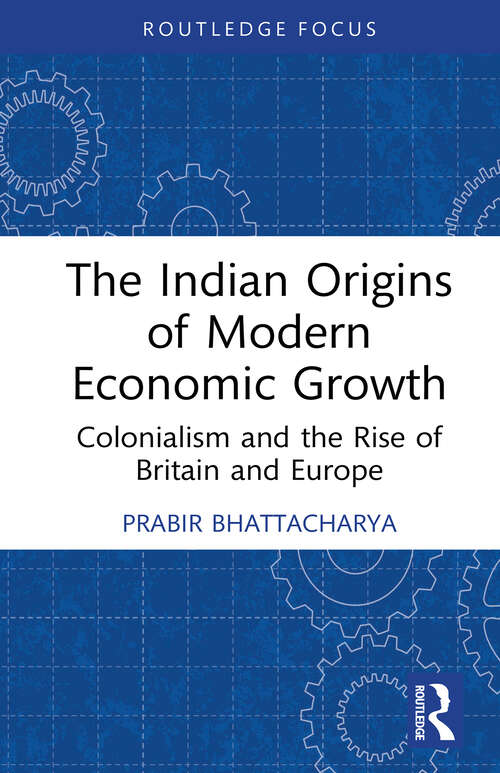
The Indian Origins of Modern Economic Growth: Colonialism and the Rise of Britain and Europe

By Prabir Bhattacharya

Business and economics, European history

Synthetic audio, Automated braille

Summary

Modern economic growth first emerged in Britain and then spread to a few other countries in western Europe and the USA. This book argues that it is her control over India which put Britain at the apex of the world… economy in the nineteenth century, and it is British policies and actions, based on her Indian foundation, which led to the globalisation of the nineteenth century – a globalisation very different from the previous globalisations in history.Technological innovations of the nineteenth century were embedded in that globalisation process. It is this which ensured that growth and innovations would not peter out this time, as they had after various “efflorescences” in history. While the increased availability of silver from the Mexican and Peruvian mines in the sixteenth and seventeenth centuries, and the Atlantic slave trade both had important consequences for global development, the decisive disjuncture that opened the path to modern economic growth was the British victory in the Battle of Plassey (1757), which in due course led to the colonisation of the whole of the subcontinent.The book is likely to be of interest to a diverse readership, beyond those interested in economic history and growth economics.

Title Details

ISBN 9781040801543
Publisher Taylor & Francis
Copyright Date 2026
Book number 6893519
Report a problem with this book

The Indian Origins of Modern Economic Growth: Colonialism and the Rise of Britain and Europe

FAQ

Which devices can I use to read books and magazines from CELA?

Answer: CELA books and magazines work with many popular accessible reading devices and apps. Find out more on ourCompatible devices and formats page.

Go to Frequently Asked Questions page

About us

The Centre for Equitable Library Access, CELA, is an accessible library service, providing books and other materials to Canadians with print disabilities.

  • Learn more about CELA
  • Privacy
  • Terms of acceptable use
  • Member libraries

Follow us

Keep up with news from CELA!

  • Subscribe to our newsletters
  • Blog
  • Facebook
  • Bluesky
  • Twitter
  • Youtube

Suggestion Box

CELA welcomes all feedback and suggestions:

  • Join our Educator Advisory Group
  • Apply for our User Advisory Group
  • Suggest a title for the collection
  • Report a problem with a book

Contact Us

Email us at help@celalibrary.ca or call us at 1-855-655-2273 for support.

Go to contact page for full details

Copyright 2025 CELA. All rights reserved.