Public library services for Canadians with print disabilities
  • Mobile accessibility tips
    • Change contrast
      • AYellow on black selected
      • ABlack on yellow selected
      • AWhite on black selected
      • ABlack on white selected
      • ADefault colours selected
    • Change text size
      • Text size Small selected
      • Text size Medium selected
      • Text size Large selected
      • Text size Maximum selected
    • Change font
      • Arial selected
      • Verdana selected
      • Comic Sans MS selected
    • Change text spacing
      • Narrow selected
      • Medium selected
      • Wide selected
  • Register
  • Log in
  • Français
  • Home
  • Newspapers
  • Magazines
  • Recommended
  • For libraries
  • Help
  • Skip to content
      • Change contrast
        • AYellow on black selected
        • ABlack on yellow selected
        • AWhite on black selected
        • ABlack on white selected
        • ADefault colours selected
      • Change text size
        • Text size Small selected
        • Text size Medium selected
        • Text size Large selected
        • Text size Maximum selected
      • Change font
        • Arial selected
        • Verdana selected
        • Comic Sans MS selected
      • Change text spacing
        • Narrow selected
        • Medium selected
        • Wide selected
  • Accessibility tips
CELAPublic library services for Canadians with print disabilities

Centre for Equitable Library Access
Public library service for Canadians with print disabilities

  • Register
  • Log in
  • Français
  • Home
  • Newspapers
  • Magazines
  • Recommended
  • For libraries
  • Help
  • Advanced search
  • Browse by category
  • Search tips
Breadcrumb
  1. Home

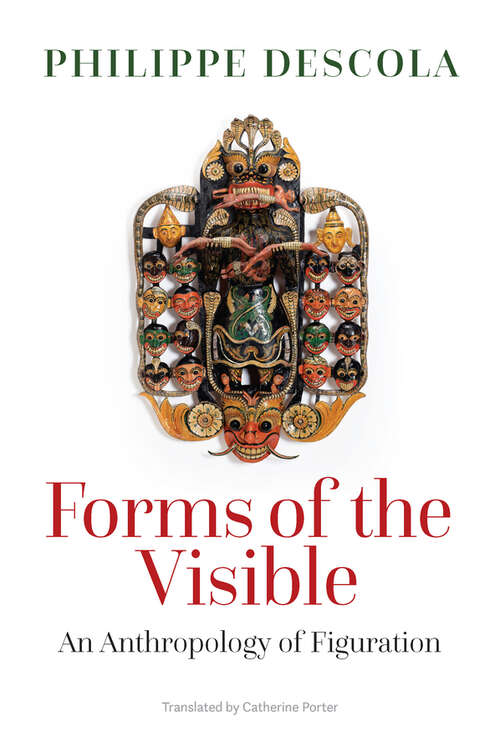
Forms of the Visible: An Anthropology of Figuration

By Philippe Descola

Customs and cultures

Synthetic audio, Automated braille

Summary

Imagery and figuration are not just figments of an artist’s imagination.  Perception and imagination are always shaped by what habit has taught us to discern.  The visual path we spontaneously trace through the world depends on where we are situated… in the four regions of the ontological archipelago: animism, naturalism, totemism or analogism. Each of these four regions corresponds to a way of conceiving the objects that make up the world, of perceiving the continuities and discontinuities in the folds of the world and of drawing the dividing lines between humans and nonhumans.  From Alaskan Yup’ik masks and Aboriginal bark paintings to miniature landscapes from the Song dynasty and Dutch Golden Age interior scenes: each image reveals, through what it shows or fails to show, a certain figurative regime, identifiable by the formal means it uses and by the device through which it can unleash its power to act.  The figurative regime enables us to grasp – sometimes better than words can – the contrasting ways of living that characterize the human condition and its relation to the nonhuman.  By comparing a great diversity of visual images and artworks, Descola masterfully lays the theoretical foundations for an anthropology of figuration.  One of the world’s leading anthropologists, Philippe Descola has developed a comparative anthropology of relations between humans and nonhumans that has revolutionized both the human sciences and our ways of thinking about the great ecological issues of our time.  His new book will be of great value to students and scholars of anthropology, visual art and art history and to anyone interested in art, culture and the relations between the human and nonhuman worlds.

Title Details

ISBN 9781509561971
Publisher Polity Press
Copyright Date 2025
Book number 6892301
Report a problem with this book

Forms of the Visible: An Anthropology of Figuration

FAQ

Which devices can I use to read books and magazines from CELA?

Answer: CELA books and magazines work with many popular accessible reading devices and apps. Find out more on ourCompatible devices and formats page.

Go to Frequently Asked Questions page

About us

The Centre for Equitable Library Access, CELA, is an accessible library service, providing books and other materials to Canadians with print disabilities.

  • Learn more about CELA
  • Privacy
  • Terms of acceptable use
  • Member libraries

Follow us

Keep up with news from CELA!

  • Subscribe to our newsletters
  • Blog
  • Facebook
  • Bluesky
  • Twitter
  • Youtube

Suggestion Box

CELA welcomes all feedback and suggestions:

  • Join our Educator Advisory Group
  • Apply for our User Advisory Group
  • Suggest a title for the collection
  • Report a problem with a book

Contact Us

Email us at help@celalibrary.ca or call us at 1-855-655-2273 for support.

Go to contact page for full details

Copyright 2025 CELA. All rights reserved.