Public library services for Canadians with print disabilities
  • Mobile accessibility tips
    • Change contrast
      • AYellow on black selected
      • ABlack on yellow selected
      • AWhite on black selected
      • ABlack on white selected
      • ADefault colours selected
    • Change text size
      • Text size Small selected
      • Text size Medium selected
      • Text size Large selected
      • Text size Maximum selected
    • Change font
      • Arial selected
      • Verdana selected
      • Comic Sans MS selected
    • Change text spacing
      • Narrow selected
      • Medium selected
      • Wide selected
  • Register
  • Log in
  • Français
  • Home
  • Newspapers
  • Magazines
  • Recommended
  • For libraries
  • Help
  • Skip to content
      • Change contrast
        • AYellow on black selected
        • ABlack on yellow selected
        • AWhite on black selected
        • ABlack on white selected
        • ADefault colours selected
      • Change text size
        • Text size Small selected
        • Text size Medium selected
        • Text size Large selected
        • Text size Maximum selected
      • Change font
        • Arial selected
        • Verdana selected
        • Comic Sans MS selected
      • Change text spacing
        • Narrow selected
        • Medium selected
        • Wide selected
  • Accessibility tips
CELAPublic library services for Canadians with print disabilities

Centre for Equitable Library Access
Public library service for Canadians with print disabilities

  • Register
  • Log in
  • Français
  • Home
  • Newspapers
  • Magazines
  • Recommended
  • For libraries
  • Help
  • Advanced search
  • Browse by category
  • Search tips
Breadcrumb
  1. Home

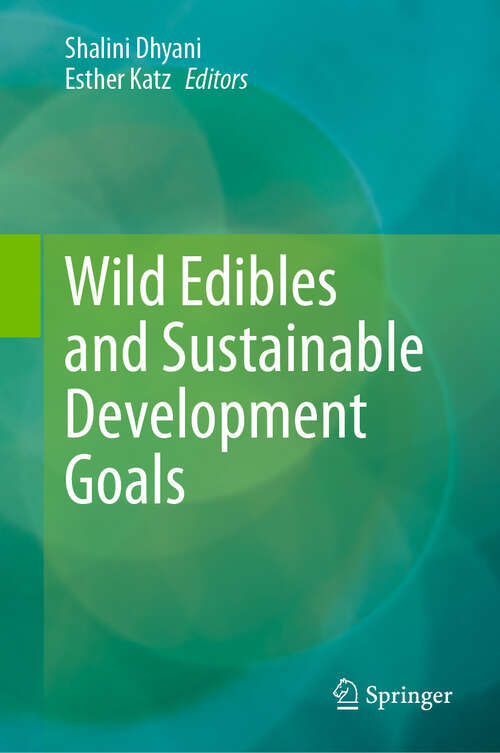
Wild Edibles and Sustainable Development Goals

By Esther Katz, Shalini Dhyani

Science and technology

Synthetic audio, Automated braille

Summary

The edited book follows a systematic and situation-sensitive approach for discussing the socio-ecological, economic, cultural, and traditional perspectives of using and promoting wild edibles. This can help in building social-ecological resilience by addressing nutritional, climate and conservation challenges in the… Anthropocene. Chapters significantly emphasize on the history, theory, future, and innovations as the main pillars of endorsing wild edibles for localizing various UN SDGs, and other relevant international promises related to climate, conservation of biodiversity and restoration of degraded landscapes. A special focus has been set on advances and opportunities for wild edibles, challenges related to sustainable harvesting concerns, and constraints of market places, accessibility, domestication. This is followed by case studies presenting the part of wild edibles in addressing food sovereignty, promoting socio-ecological resilience and sense of belongingness among locals. Chapters cover the latest evidence-based approach in diagnosis and management of ecosystems from Africa, Europe, North and South America, South Caucasus region of Eurasia, North, South and Southeast Asia. Case studies help to understand implications and concerns of promoting wild edibles as future food in a fast-expanding and climate vulnerable world. Chapters cover present-day issues and challenges dealing with food security and sovereignty, sustainability and environmental change. They incite at taking the knowledge and practices of IPLCs as models. They also attempt to strengthen and enrich the knowledge base on diverse related complex issues related to wild edibles by integrating the values and importance of biodiversity, threatened species and ecosystems, and emerging drivers of biodiversity loss. The volume highlights how harvesting and consuming wild edibles enhance nutritional security, health benefits, climate resilience, improve economic opportunities and trade-offs for long-term sustainability. The volume shows as well that supporting future food species would influence the ecosystem and biodiversity-inclusive SDG localization, and also reduce land degradation due to agriculture intensification. The emerging roles of integrative socio-ecological as well as techno-cultural factors in promoting and including wild species as nutritional support are key features of this book.

Title Details

ISBN 9789819536245
Publisher Springer Nature Singapore
Copyright Date 2026
Book number 6891276
Report a problem with this book

Wild Edibles and Sustainable Development Goals

FAQ

Which devices can I use to read books and magazines from CELA?

Answer: CELA books and magazines work with many popular accessible reading devices and apps. Find out more on ourCompatible devices and formats page.

Go to Frequently Asked Questions page

About us

The Centre for Equitable Library Access, CELA, is an accessible library service, providing books and other materials to Canadians with print disabilities.

  • Learn more about CELA
  • Privacy
  • Terms of acceptable use
  • Member libraries

Follow us

Keep up with news from CELA!

  • Subscribe to our newsletters
  • Blog
  • Facebook
  • Bluesky
  • Twitter
  • Youtube

Suggestion Box

CELA welcomes all feedback and suggestions:

  • Join our Educator Advisory Group
  • Apply for our User Advisory Group
  • Suggest a title for the collection
  • Report a problem with a book

Contact Us

Email us at help@celalibrary.ca or call us at 1-855-655-2273 for support.

Go to contact page for full details

Copyright 2025 CELA. All rights reserved.