Public library services for Canadians with print disabilities
  • Mobile accessibility tips
    • Change contrast
      • AYellow on black selected
      • ABlack on yellow selected
      • AWhite on black selected
      • ABlack on white selected
      • ADefault colours selected
    • Change text size
      • Text size Small selected
      • Text size Medium selected
      • Text size Large selected
      • Text size Maximum selected
    • Change font
      • Arial selected
      • Verdana selected
      • Comic Sans MS selected
    • Change text spacing
      • Narrow selected
      • Medium selected
      • Wide selected
  • Register
  • Log in
  • Français
  • Home
  • Newspapers
  • Magazines
  • Recommended
  • For libraries
  • Help
  • Skip to content
      • Change contrast
        • AYellow on black selected
        • ABlack on yellow selected
        • AWhite on black selected
        • ABlack on white selected
        • ADefault colours selected
      • Change text size
        • Text size Small selected
        • Text size Medium selected
        • Text size Large selected
        • Text size Maximum selected
      • Change font
        • Arial selected
        • Verdana selected
        • Comic Sans MS selected
      • Change text spacing
        • Narrow selected
        • Medium selected
        • Wide selected
  • Accessibility tips
CELAPublic library services for Canadians with print disabilities

Centre for Equitable Library Access
Public library service for Canadians with print disabilities

  • Register
  • Log in
  • Français
  • Home
  • Newspapers
  • Magazines
  • Recommended
  • For libraries
  • Help
  • Advanced search
  • Browse by category
  • Search tips
Breadcrumb
  1. Home

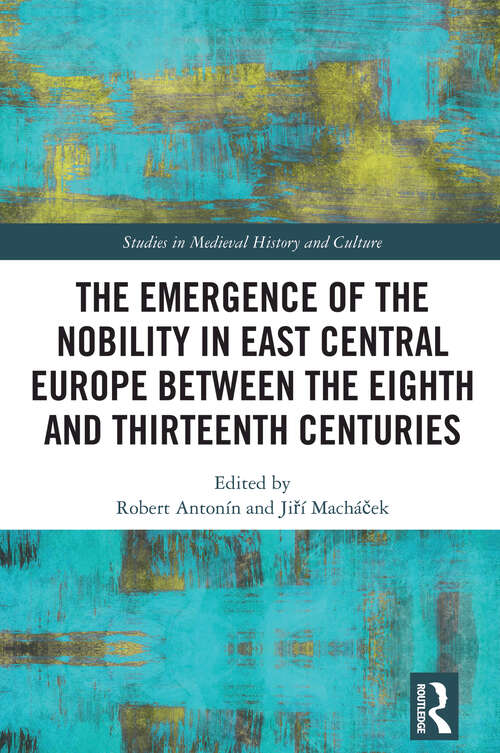
The Emergence of the Nobility in East Central Europe between the Eighth and Thirteenth Centuries (Studies in Medieval History and Culture)

By Robert Antonín, Jiří Macháček

European history

Synthetic audio, Automated braille

Summary

The Emergence of the Nobility in East Central Europe between the Eighth and Thirteenth Centuries explores the formation and evolution of medieval elites in the frontier and peripheral regions of the Frankish/East Frankish Empire and East Central Europe between the… eighth and thirteenth centuries. It addresses the dynamics of elite emergence during a transformative era marked by the interaction of established centres and developing borderlands. By focusing on regions such as Saxony, Poland, the Baltic, Bavaria, Carinthia, the Czech lands, Great Moravia, Hungary, and Croatia, the book offers a geographically broad perspective on the mechanisms of power and social hierarchy in early and high medieval Europe.This book presents the results of comparative research into how elite status was constructed and legitimised, investigating whether this occurred through centralised imposition or organic processes of alliance-building, gift exchange and negotiation. It draws on Pierre Bourdieu’s Theory of Practice to analyse the economic, cultural, social and symbolic capital that defined elite status. The volume also considers the influences of indigenous development versus cultural transfer in shaping elite identities and practices. Each contribution offers a case study or regional focus, collectively illustrating both shared patterns and local specificities in elite transformation across centuries.Targeted at scholars and students of medieval archaeology and history, this interdisciplinary work is equally relevant to researchers interested in social structures, cultural exchange and political power in premodern Europe. Its synthesis of theory, comparative methodology and empirical data makes it a valuable resource for both academic study and future research on elite formation in medieval frontier societies.

Title Details

ISBN 9781040681640
Publisher Taylor & Francis
Copyright Date 2026
Book number 6891366
Report a problem with this book

The Emergence of the Nobility in East Central Europe between the Eighth and Thirteenth Centuries (Studies in Medieval History and Culture)

FAQ

Which devices can I use to read books and magazines from CELA?

Answer: CELA books and magazines work with many popular accessible reading devices and apps. Find out more on ourCompatible devices and formats page.

Go to Frequently Asked Questions page

About us

The Centre for Equitable Library Access, CELA, is an accessible library service, providing books and other materials to Canadians with print disabilities.

  • Learn more about CELA
  • Privacy
  • Terms of acceptable use
  • Member libraries

Follow us

Keep up with news from CELA!

  • Subscribe to our newsletters
  • Blog
  • Facebook
  • Bluesky
  • Twitter
  • Youtube

Suggestion Box

CELA welcomes all feedback and suggestions:

  • Join our Educator Advisory Group
  • Apply for our User Advisory Group
  • Suggest a title for the collection
  • Report a problem with a book

Contact Us

Email us at help@celalibrary.ca or call us at 1-855-655-2273 for support.

Go to contact page for full details

Copyright 2025 CELA. All rights reserved.