Public library services for Canadians with print disabilities
  • Mobile accessibility tips
    • Change contrast
      • AYellow on black selected
      • ABlack on yellow selected
      • AWhite on black selected
      • ABlack on white selected
      • ADefault colours selected
    • Change text size
      • Text size Small selected
      • Text size Medium selected
      • Text size Large selected
      • Text size Maximum selected
    • Change font
      • Arial selected
      • Verdana selected
      • Comic Sans MS selected
    • Change text spacing
      • Narrow selected
      • Medium selected
      • Wide selected
  • Register
  • Log in
  • Français
  • Home
  • Newspapers
  • Magazines
  • Recommended
  • For libraries
  • Help
  • Skip to content
      • Change contrast
        • AYellow on black selected
        • ABlack on yellow selected
        • AWhite on black selected
        • ABlack on white selected
        • ADefault colours selected
      • Change text size
        • Text size Small selected
        • Text size Medium selected
        • Text size Large selected
        • Text size Maximum selected
      • Change font
        • Arial selected
        • Verdana selected
        • Comic Sans MS selected
      • Change text spacing
        • Narrow selected
        • Medium selected
        • Wide selected
  • Accessibility tips
CELAPublic library services for Canadians with print disabilities

Centre for Equitable Library Access
Public library service for Canadians with print disabilities

  • Register
  • Log in
  • Français
  • Home
  • Newspapers
  • Magazines
  • Recommended
  • For libraries
  • Help
  • Advanced search
  • Browse by category
  • Search tips
Breadcrumb
  1. Home

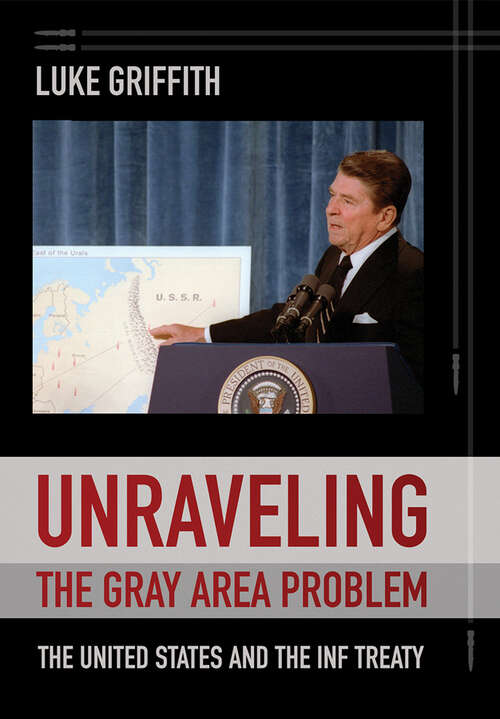
Unraveling the Gray Area Problem: The United States and the INF Treaty

By Luke Griffith

United States history, Politics and government

Synthetic audio, Automated braille

Summary

In Unraveling the Gray Area Problem, Luke Griffith examines the US role in why the Intermediate-Range Nuclear Forces (INF) Treaty took almost a decade to negotiate and then failed in just thirty years. The INF Treaty enhanced Western security by… prohibiting US and Russian ground-based missiles with maximum ranges of 500 to 5,500 kilometers. Significantly, it eliminated hundreds of Soviet SS-20 missiles, which could annihilate targets throughout Eurasia in minutes. Through close scrutiny of US theater nuclear policy from 1977 to 1987, Griffith describes the Carter administration's masterminding of the dual-track decision of December 1979, the North Atlantic Treaty Organization (NATO) initiative that led to the INF Treaty. The Reagan administration, in turn, overcame bureaucratic infighting, Soviet intransigence, and political obstacles at home and abroad to achieve a satisfactory outcome in the INF negotiations. Disagreements between the US and Russia undermined the INF Treaty and led to its dissolution in 2019. Meanwhile, the US is developing a new generation of ground-based, INF-type missiles that will have an operational value on the battlefield. Griffith urges policymakers to consider the utility of INF-type missiles in new arms control negotiations. Understanding the scope and consistency of US arms control policy across the Carter and Reagan administrations offers important lessons for policymakers in the twenty-first century.

Title Details

ISBN 9781501773082
Publisher Cornell University Press
Copyright Date 2023
Book number 5773480
Report a problem with this book

Unraveling the Gray Area Problem: The United States and the INF Treaty

FAQ

Which devices can I use to read books and magazines from CELA?

Answer: CELA books and magazines work with many popular accessible reading devices and apps. Find out more on ourCompatible devices and formats page.

Go to Frequently Asked Questions page

About us

The Centre for Equitable Library Access, CELA, is an accessible library service, providing books and other materials to Canadians with print disabilities.

  • Learn more about CELA
  • Privacy
  • Terms of acceptable use
  • Member libraries

Follow us

Keep up with news from CELA!

  • Subscribe to our newsletters
  • Blog
  • Facebook
  • Bluesky
  • Twitter
  • Youtube

Suggestion Box

CELA welcomes all feedback and suggestions:

  • Join our Educator Advisory Group
  • Apply for our User Advisory Group
  • Suggest a title for the collection
  • Report a problem with a book

Contact Us

Email us at help@celalibrary.ca or call us at 1-855-655-2273 for support.

Go to contact page for full details

Copyright 2025 CELA. All rights reserved.