Title search results
Showing 1 - 6 of 6 items
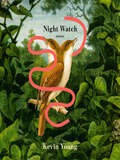
Night Watch continues one of the most vital currents in contemporary poetry, transforming history and its silences into lyric through…
the poet’s eloquent invitation: ‘O wounded soul,/ speak.’” —The New York Times Following on his exquisite Stones , Kevin Young’s new collection, written over the span of sixteen years, shapes stories of loss and legacy, inspired in part by other lives. After starting in the bayous of his family's Louisiana, Young journeys to further states of mind in “All Souls,” evoking “The whale / who finds the shore / & our poor prayers.” Another central sequence, “The Two-Headed Nightingale,” is spoken by Millie-Christine McCoy, the famous conjoined African American “Carolina Twins.” Born into enslavement, stolen, and then displayed by P. T. Barnum and others, the twins later toured the world as free women, their alto and soprano voices harmonizing their own way. Young’s poem explores their evolving philosophical selfhood and pluralities: “As one we sang, /we spake— / She was the body / I the soul / Without one / Perishes the whole.” In “Darkling,” a cycle of poems inspired by Dante’s Divine Comedy , Young expands and embroiders the circles of Hell, drawing a cosmology of both loneliness and accompaniment, where “the dead don’t know / what to do / with themselves.” Young writes of grief and hope as familiar yet surprising states: “It’s like a language, / loss—,” he writes, “learnt only / by living—there—.” Evoking the history of poetry, from the darkling thrush to the darkling plain, Young is defiant and playful on the way through purgatory to a kind of paradise. When he goes, he warns, “don't dare sing Amazing Grace ”—that “National / Anthem of Suffering.” Instead, he suggests, “When I Fly Away, / Don't dare hold no vigil . . . Just burn the whole / Town on down.” This collection will stand as one of Young’s best—his voice shaping sorrow with music, wisdom, heartache, and wit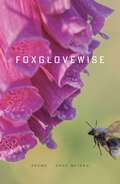
Ange Mlinko, whose poetry is “irresistible” (Los Angeles Review of Books), opens our perception of other lives, or lives unlived.Foxglovewise…
is, at its core, a response to the singular experience of the loss of one’s parents. It begins at an Eastern Orthodox Epiphany ritual in Florida and ends in a cemetery in Los Angeles. Yet, as with Ange Mlinko’s other books of poetry, the collection uses geography as a trope for the ways in which we try to map out our lives and make them legible, even as poetry, music, and paintings suggest that much of what happens, or matters, to us is “not on the maps” (not to mention “the apps”). Whether it’s Europa borne over the waves, or gravestones bearing aliases rather than birth names, or books bequeathed to us by relatives in languages we can’t read, we live “up in the air” or “on the wing” and not in fixed coordinates.Mlinko's poetry is suffused with wit, erudition, beauty, and boundless energy. As Declan Ryan wrote of her work in The Times Literary Supplement, “A reader could be merely dazzled by all this surface stylishness . . . but then they would miss the heart beneath it all.” Foxglovewise is a direct line to the author’s heart.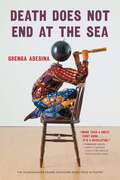
Winner of the Raz/Shumaker Prairie Schooner Book Prize in Poetry In Gbenga Adesina&’s groundbreaking debut book of poems, a defiant…
and wise exploration of exile, voyages, and spiritual odysseys, we encounter figures embarking on journeys haunted by history—a son keeps dreaming he carried his dead father across the sea; a young Black father, tired of fear and breathlessness, travels with his son in search of the ghost of James Baldwin—to Paris, the south of France, Turkey, and Senegal to investigate his ancestral roots; and finally, a group of immigrants on small boats in the middle of the Mediterranean Sea sing in order not to drown, in a stunning sequence that invokes the middle passage. In a lyrical voice at once new and surprisingly ancient, Adesina&’s Death Does Not End at the Sea explores the complexity of elusive citizenship, an immigrant&’s brokenhearted prayer for a new beginning, a chorus of elegies, and a cosmic love song between the living and the dead.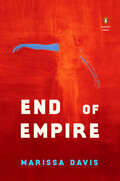
From a prizewinning poet whose work &“points to an unfathomably bright future for the canon&” (Danez Smith), a stunningly lush…
collection about desire, resilience, and our fraught and ecstatic relationship with the natural worldA collection as remarkable for the force of its feeling as for the range of its vision, End of Empire explores the tensions of Black and American identity within an ecological framework. Inspired by the language and landscape of the poet&’s rural Kentucky hometown and the ways that inherited religious and political narratives shape our relationships with our surroundings and ourselves, these poems reckon with the ways the speaker, their body, and their natural and ideological surroundings continuously remake each other. Formally dynamic, emotionally resonant, and rich with biblical, mythological, and historical allusions, these are elegant, impeccably crafted pieces that evoke the fearsome power of nature and of the tangled, sensual self.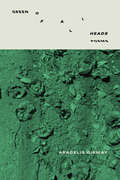
*The Whiting Award-winning poet returns*Written over the span of a decade, GREEN OF ALL HEADS is a work of formal…
range and emotional urgency. In the coinciding wakes of tragic loss and new motherhood, Aracelis Girmay examines the entangled temporalities of an aging parent and newly born children. This vital work grapples with what it means to attend to life in the context of corporate industries of birth and death. In language shaped by these pressures, she turns to what is small, unruly, nationless, plural — flowers, speech — to reach toward new relational and political possibility. Away from the fixed and monumental, and toward that which is fleeting, she writes: “— i am learning to lift — my voice — like a flower — in — a field of flowers —” The result is a language broken and emboldened by love.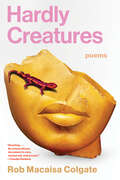
&“Dazzling. . . . An extraordinary document in care, mutual aid, and access.&”—Claudia RankineAn imaginative and unforgettable debut poetry collection…
about the joys and complexities of the disability community from 2024 Ruth Lilly fellow Rob Macaisa Colgate.Brilliant and innovative, Rob Macaisa Colgate&’s debut poetry collection, Hardly Creatures, takes the form—visually and metaphorically—of an accessible art museum. Through nine sections that act as gallery rooms, the book shepherds the reader through the radiance and mess of the disability community.At the heart of the collection is an exploration and recognition of access intimacy. Marked with universal access symbols to guide the way, poems mimic sensory rooms, tactile replicas, benches for resting, and more; &“the body of a poem&” itself is reimagined through formal experimentation, as abecedarians are scrambled out of order and sestinas are pressurized into new sequences. These poems also play with pop culture allusions, social media posts, and the infinite possibilities within queer love and deep friendships. With lyrical clarity and attention to language, Hardly Creatures reaches out and offers inventive, heartfelt insights for all readers, and celebrates the disability community through the lens of a visionary new voice in poetry.