Public library services for Canadians with print disabilities
  • Mobile accessibility tips
    • Change contrast
      • AYellow on black selected
      • ABlack on yellow selected
      • AWhite on black selected
      • ABlack on white selected
      • ADefault colours selected
    • Change text size
      • Text size Small selected
      • Text size Medium selected
      • Text size Large selected
      • Text size Maximum selected
    • Change font
      • Arial selected
      • Verdana selected
      • Comic Sans MS selected
    • Change text spacing
      • Narrow selected
      • Medium selected
      • Wide selected
  • Register
  • Log in
  • Français
  • Home
  • Newspapers
  • Magazines
  • Recommended
  • For libraries
  • Help
  • Skip to content
      • Change contrast
        • AYellow on black selected
        • ABlack on yellow selected
        • AWhite on black selected
        • ABlack on white selected
        • ADefault colours selected
      • Change text size
        • Text size Small selected
        • Text size Medium selected
        • Text size Large selected
        • Text size Maximum selected
      • Change font
        • Arial selected
        • Verdana selected
        • Comic Sans MS selected
      • Change text spacing
        • Narrow selected
        • Medium selected
        • Wide selected
  • Accessibility tips
CELAPublic library services for Canadians with print disabilities

Centre for Equitable Library Access
Public library service for Canadians with print disabilities

  • Register
  • Log in
  • Français
  • Home
  • Newspapers
  • Magazines
  • Recommended
  • For libraries
  • Help
  • Advanced search
  • Browse by category
  • Search tips
Breadcrumb
  1. Home

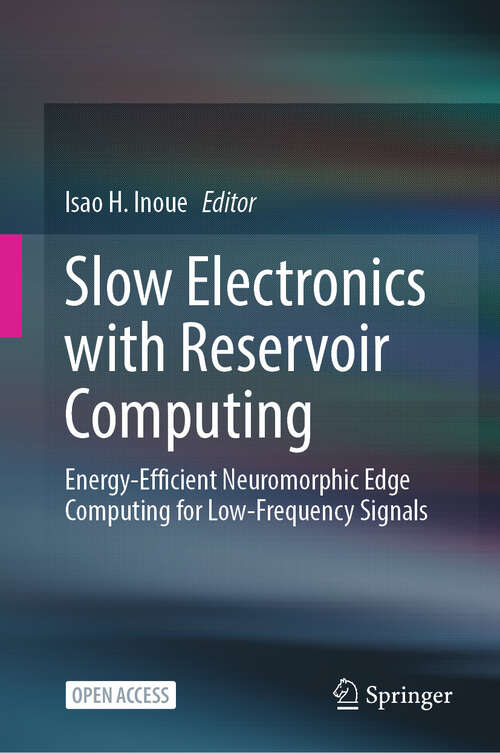
Slow Electronics with Reservoir Computing: Energy-Efficient Neuromorphic Edge Computing for Low-Frequency Signals

By Isao H. Inoue

Computers and internet, General non-fiction, Science and technology

Synthetic audio, Automated braille

Summary

This open access book discusses &“slow electronics&”, the study of devices processing signals with low frequencies. Computers have the remarkable ability to process data at high speeds, but they encounter difficulties when handling signals with low frequencies of less than… ~100Hz. They unexpectedly require a substantial amount of energy. This poses a challenge for such as biomedical wearables and environmental monitors that need real-time processing of slow signals, especially in energy-limited 'edge&’ environments with small batteries. One possible solution to this issue is event-driven processing, which entails the use of non-volatile memory to read/write data and parameters every time a slow (sporadic) signal is detected. However, this approach is highly energy-consuming and unsuitable for the edge environments. To address this challenge, the authors propose &“slow electronics&” by developing electronic devices and systems that can process low-frequency signals more efficiently. The biological brain is an excellent example of the slow electronics, as it processes low-frequency signals in real time with exceptional energy efficiency. The authors have employed reservoir computing with a spiking neural network (SNN) to simulate the learning and inference of the brain. The integration of slow electronics with SNN reservoir computing allows for real-time data processing in edge environments without an internet connection. This will reveal the determinism or periodicity behind unconscious behaviours and habits that have been difficult to explore due to privacy barriers thus far. Moreover, it may provide a more profound understanding of a craftsman's skills, which they may not even be aware of. This book emphasises the most recent concepts and technological developments in slow electronics. Discussion on the captivating subject of slow electronics are given by delving into the complexities of reservoir calculation, analogue CMOS circuits, artificial neuromorphic devices, and numerical simulation with extended time constants, paving the way for more people-friendly devices in the future.

Title Details

ISBN 9789819683833
Publisher Springer Nature Singapore
Copyright Date 2026
Book number 6899460
Report a problem with this book

Slow Electronics with Reservoir Computing: Energy-Efficient Neuromorphic Edge Computing for Low-Frequency Signals

FAQ

Which devices can I use to read books and magazines from CELA?

Answer: CELA books and magazines work with many popular accessible reading devices and apps. Find out more on ourCompatible devices and formats page.

Go to Frequently Asked Questions page

About us

The Centre for Equitable Library Access, CELA, is an accessible library service, providing books and other materials to Canadians with print disabilities.

  • Learn more about CELA
  • Privacy
  • Terms of acceptable use
  • Member libraries

Follow us

Keep up with news from CELA!

  • Subscribe to our newsletters
  • Blog
  • Facebook
  • Bluesky
  • Twitter
  • Youtube

Suggestion Box

CELA welcomes all feedback and suggestions:

  • Join our Educator Advisory Group
  • Apply for our User Advisory Group
  • Suggest a title for the collection
  • Report a problem with a book

Contact Us

Email us at help@celalibrary.ca or call us at 1-855-655-2273 for support.

Go to contact page for full details

Copyright 2025 CELA. All rights reserved.