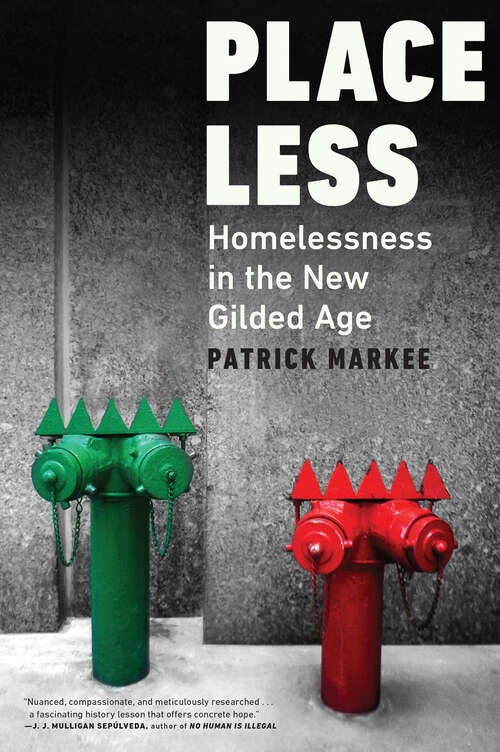
Placeless: Homelessness in the New Gilded Age
Politique et gouvernement, Sociologie, Essais et documents généraux
Audio avec voix de synthèse, Braille automatisé
Résumé
In the tradition of Matthew Desmond's Evicted, a longtime housing activist presents a vivid and myth-breaking account of why homelessness endures in contemporary America...Millions of people are affected by homelessness, but media pundits and politicians see homelessness as a social… work problem, or a matter of personal pathology, or some peculiar subspecies of urban poverty.Informed by the author&’s own front-line experiences from more than two decades working as an advocate for homeless people in New York City and his work with housing activists across the country. Placeless: Homelessness in the New Gilded Age presents an alternative and innovative, wide-angle view of homelessness and displacement in New York and elsewhere.A tour of the geography of homelessness in New York City, where some 100,000 people a night sleep in the city&’s shelter system, Markee visits certain city landmarks where homeless New Yorkers struggle to survive:armories once built to quarter militias who put down worker uprisings a train tunnel underneath Riverside Parka grim intake center where infants, children, and families were forced to sleep on office floorsa former psychiatric wing of Bellevue Hospital now sheltering hundreds of homeless men each nighta Manhattan park surrounded by luxury condos where the police routinely harassed homeless street-dwellersBlending historical analysis, urban theory, and the latest policy research, Markee considers homelessness in America as a tragic yet inevitable consequence of economic shifts inaugurated in the Reagan era, worsening inequality and housing affordability, systemic racism, and neoliberal government policies.At a moment where tabloids and politicians use homelessness as an excuse to whip up fear, Placeless is a powerful and moving account of a social problem whose solution is entirely possible.