Résultats de recherche de titre
Articles 1 à 5 sur 5

DAISY audio (Téléchargement direct), DAISY audio (Zip)
Etats-Unis (histoire), Peuples autochtones (histoire), Coutumes et cultures, Histoire
Audio avec voix humaine
The first intersectional history of the Black and Native American struggle for freedom in our country that also reframes our…
understanding of who was Indigenous in early America Beginning with pre-Revolutionary America and moving into the movement for Black lives and contemporary Indigenous activism, Afro-Indigenous historian, Kyle T. Mays argues that the foundations of the US are rooted in antiblackness and settler colonialism, and that these parallel oppressions continue into the present. He explores how Black and Indigenous peoples have always resisted and struggled for freedom, sometimes together, and sometimes apart. Whether to end African enslavement and Indigenous removal or eradicate capitalism and colonialism, Mays show how the fervor of Black and Indigenous peoples calls for justice have consistently sought to uproot white supremacy. Mays uses a wide-array of historical activists and pop culture icons, &“sacred&” texts, and foundational texts like the Declaration of Independence and Democracy in America. He covers the civil rights movement and freedom struggles of the 1960s and 1970s, and explores current debates around the use of Native American imagery and the cultural appropriation of Black culture. Mays compels us to rethink both our history as well as contemporary debates and to imagine the powerful possibilities of Afro-Indigenous solidarity
DAISY audio (Téléchargement direct), DAISY audio (Zip)
États-Unis (voyage et géographie), Etats-Unis (histoire)
Audio avec voix humaine
The 1619 Project&’s lyrical picture book in verse chronicles the consequences of slavery and the history of Black resistance in…
the United States, thoughtfully rendered by Pulitzer Prize-winning journalist Nikole Hannah-Jones and Newbery honor-winning author Renée Watson. A young student receives a family tree assignment in school, but she can only trace back three generations. Grandma gathers the whole family, and the student learns that 400 years ago, in 1619, their ancestors were stolen and brought to America by white slave traders. But before that, they had a home, a land, a language. She learns how the people said to be born on the water survived. And the people planted dreams and hope, willed themselves to keep living, living. And the people learned new words for love for friend for family for joy for grow for home. With powerful verse and striking illustrations by Nikkolas Smith, Born on the Water provides a pathway for readers of all ages to reflect on the origins of American identity
DAISY audio (Téléchargement direct), DAISY audio (Zip)
Coutumes et cultures, Histoire, Etats-Unis (histoire)
Audio avec voix humaine
The incredible true story of the last ship to carry enslaved people to America, the remarkable town its survivors founded…
after emancipation, and the complicated legacy their descendants carry with them to this day—by the journalist who discovered the ship's remains. Fifty years after the Atlantic slave trade was outlawed, the Clotilda became the last ship in history to bring enslaved Africans to the United States. The ship was scuttled and burned on arrival to hide evidence of the crime, allowing the wealthy perpetrators to escape prosecution. Despite numerous efforts to find the sunken wreck, Clotilda remained hidden for the next 160 years. But in 2019, journalist Ben Raines made international news when he successfully concluded his obsessive quest through the swamps of Alabama to uncover one of our nation's most important historical artifacts. Traveling from Alabama to the ancient African kingdom of Dahomey in modern-day Benin, Raines recounts the ship's perilous journey, the story of its rediscovery, and its complex legacy. Against all odds, Africatown, the Alabama community founded by the captives of the Clotilda , prospered in the Jim Crow South. Zora Neale Hurston visited in 1927 to interview Cudjo Lewis, telling the story of his enslavement in the New York Times bestseller Barracoon . And yet the haunting memory of bondage has been passed on through generations. Clotilda is a ghost haunting three communities—the descendants of those transported into slavery, the descendants of their fellow Africans who sold them, and the descendants of their American enslavers. This connection binds these groups together to this day. At the turn of the century, descendants of the captain who financed the Clotilda's journey lived nearby—where, as significant players in the local real estate market, they disenfranchised and impoverished residents of Africatown. From these parallel stories emerges a profound depiction of America as it struggles to grapple with the traumatic past of slavery and the ways in which racial oppression continue to this day. And yet, at its heart, The Last Slave Ship remains optimistic – an epic tale of one community's triumphs over great adversity and a celebration of the power of human curiosity to uncover the truth about our past and heal its wounds
DAISY audio (Téléchargement direct), DAISY audio (Zip)
Anthologies, Famille et relations familiales , Humour
Audio avec voix humaine
David Sedaris, the "champion storyteller," ( Los Angeles Times ) returns with his first new collection of personal essays since…
the bestselling Calypso. Back when restaurant menus were still printed on paper, and wearing a mask—or not—was a decision made mostly on Halloween, David Sedaris spent his time doing normal things. As Happy-Go-Lucky opens, he is learning to shoot guns with his sister, visiting muddy flea markets in Serbia, buying gummy worms to feed to ants, and telling his nonagenarian father wheelchair jokes. But then the pandemic hits, and like so many others, he's stuck in lockdown, unable to tour and read for audiences, the part of his work he loves most. To cope, he walks for miles through a nearly deserted city, smelling only his own breath. He vacuums his apartment twice a day, fails to hoard anything, and contemplates how sex workers and acupuncturists might be getting by during quarantine. As the world gradually settles into a new reality, Sedaris too finds himself changed. His offer to fix a stranger's teeth rebuffed, he straightens his own, and ventures into the world with new confidence. Newly orphaned, he considers what it means, in his seventh decade, no longer to be someone's son. And back on the road, he discovers a battle-scarred America: people weary, storefronts empty or festooned with Help Wanted signs, walls painted with graffiti reflecting the contradictory messages of our time: Eat the Rich. Trump 2024. Black Lives Matter. In Happy-Go-Lucky, David Sedaris once again captures what is most unexpected, hilarious, and poignant about these recent upheavals, personal and public, and expresses in precise language both the misanthropy and desire for connection that drive us all. If we must live in interesting times, there is no one better to chronicle them than the incomparable David Sedaris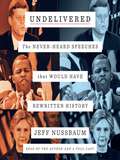
DAISY audio (Téléchargement direct), DAISY audio (Zip)
Anthologies, Histoire
Audio avec voix humaine
"There may be no more important listen regarding the fate of the nation's democracy than this historical record."- AudioFile. This…
program is read by the author and full cast, includes actual audio clips from historical and political figures, and has actors narrating the entire undelivered speeches throughout. A fascinating insight into notable speeches that were never delivered, showing what could have been if history had gone down a different path For almost every delivered speech, there exists an undelivered opposite. These "second speeches" provide alternative histories of what could have been if not for schedule changes, changes of heart, or momentous turns of events. In Undelivered , political speechwriter Jeff Nussbaum presents the most notable speeches the public never heard, from Dwight Eisenhower's apology for a D-Day failure to Richard Nixon's refusal to resign the presidency, and even Hillary Clinton's acceptance for a 2016 victory—the latter never seen until now. Examining the content of these speeches and the context of the historic moments that almost came to be, Nussbaum considers not only what they tell us about the past but also what they can inform us about our present.