Title search results
Showing 1 - 5 of 5 items

Professor of modern history examines Scotland's politics, laws, society, religious institutions, schools and universities, culture, and relationship with the world,…
including the factors that have distinguished it from England both before and after Union. 2008
Overview of the physical, intellectual, emotional, and social changes that children go through between puberty and adulthood. Includes discussion of…
parent-child and peer-group relationships, the development of identity, risk-taking and antisocial behavior, and sexual activity. 2016
Psychiatrist demystifies dreaming, describing the paradigm shift from content and Freudian psychoanalysis to the study of characteristics distinguishing dreaming from…
waking. Discusses neurobiological discoveries made possible by brain imaging technology, allowing brain- in-action observation, and showing that waking and dreaming are two states of consciousness determined by brain chemistry. 2002
Professor of organization studies draws on psychology, sociology, management, and social history for this multidisciplinary account of work--as a concept…
and as practical experience. Examines the cultural and social factors that influence the way we work, the ethics of certain types of work, and factors affecting work's future. 2012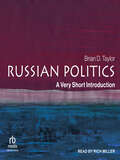
Russia is rarely out of the news. Yet Russian politics can be difficult to understand. It is powerfully shaped by…
large, impersonal forces such as geography, and Russia's place in the international political and economic system. At the same time, Russia's formal political institutions, such as the Constitution and electoral procedures, are relatively weak and manipulable compared to those of stable, established democracies. Under these circumstances, powerful leaders represent a source of potential dynamism and change. This Very Short Introduction provides a guide to understanding Russian Politics that goes beyond the headlines, offering a vivid account of the key forces driving Russian politics. It places Russia in a global context while explaining its internal political development. Several major themes run through the book, including the primacy of the state over society, the role of the so-called "West," which has represented a source of inspiration, of threat, and of competition for generations of Russians, and the collapse of the Soviet Union in 1991. The Soviet collapse brought about dramatic change across multiple spheres, from the nature of the political and economic system to the country's borders and who counted as a citizen. To this day, Russia is still working its way through the consequences of these transformations