Public library services for Canadians with print disabilities
  • Mobile accessibility tips
    • Change contrast
      • AYellow on black selected
      • ABlack on yellow selected
      • AWhite on black selected
      • ABlack on white selected
      • ADefault colours selected
    • Change text size
      • Text size Small selected
      • Text size Medium selected
      • Text size Large selected
      • Text size Maximum selected
    • Change font
      • Arial selected
      • Verdana selected
      • Comic Sans MS selected
    • Change text spacing
      • Narrow selected
      • Medium selected
      • Wide selected
  • Register
  • Log in
  • Français
  • Home
  • Newspapers
  • Magazines
  • Recommended
  • For libraries
  • Help
  • Skip to content
      • Change contrast
        • AYellow on black selected
        • ABlack on yellow selected
        • AWhite on black selected
        • ABlack on white selected
        • ADefault colours selected
      • Change text size
        • Text size Small selected
        • Text size Medium selected
        • Text size Large selected
        • Text size Maximum selected
      • Change font
        • Arial selected
        • Verdana selected
        • Comic Sans MS selected
      • Change text spacing
        • Narrow selected
        • Medium selected
        • Wide selected
  • Accessibility tips
CELAPublic library services for Canadians with print disabilities

Centre for Equitable Library Access
Public library service for Canadians with print disabilities

  • Register
  • Log in
  • Français
  • Home
  • Newspapers
  • Magazines
  • Recommended
  • For libraries
  • Help
  • Advanced search
  • Browse by category
  • Search tips
Breadcrumb
  1. Home

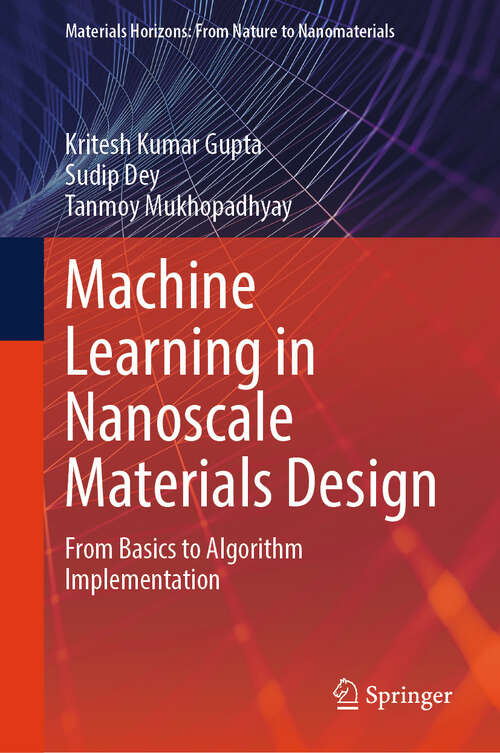
Machine Learning in Nanoscale Materials Design: From Basics to Algorithm Implementation (Materials Horizons: From Nature to Nanomaterials)

By Sudip Dey, Tanmoy Mukhopadhyay, Kritesh Kumar Gupta

Computers and internet, General non-fiction, Science and technology

Synthetic audio, Automated braille

Summary

This book provides a comprehensive overview of data-driven nano-scale characterization of materials. It covers the concept of accelerated computational characterization of nano-materials by individually addressing the detailed understanding of molecular dynamics simulation, machine learning, and interface of molecular dynamics and… machine learning for establishing the foundation of materials informatics. It further presents a methodology for integrating molecular simulation with computationally efficient machine learning methods. The book aims to present a comprehensive understanding of the synergy between atomistic simulations and data-driven descriptive analytics. The contents of the book are presented as end-to-end projects for solving a specific problem associated with the structural application of the materials and challenges in performing large-scale molecular dynamics simulations. The proposed book emphasizes on the successful application of machine learning driven molecular dynamics simulation framework in studying low-dimensional and high-dimensional materials, as well as high entropy alloys. It also explores force-field modeling, optimization strategies, uncertainty quantification, sensitivity analysis, and the essential programming skills needed for materials informatics. Readers can expect to explore a range of exciting topics, including a detailed overview of molecular dynamics simulation, the intricate interface between machine learning and simulation techniques, and a data-driven approach to understanding low-dimensional materials. The book offers a comprehensive understanding of data analytics in materials characterization and subsequent data visualization. The computational framework proposed in the book will be useful in envisioning the bottom-up design pathway for harnessing the physical characteristics of materials systems. 

Title Details

ISBN 9789819526604
Publisher Springer Nature Singapore
Copyright Date 2025
Book number 6897605
Report a problem with this book

Machine Learning in Nanoscale Materials Design: From Basics to Algorithm Implementation (Materials Horizons: From Nature to Nanomaterials)

FAQ

Which devices can I use to read books and magazines from CELA?

Answer: CELA books and magazines work with many popular accessible reading devices and apps. Find out more on ourCompatible devices and formats page.

Go to Frequently Asked Questions page

About us

The Centre for Equitable Library Access, CELA, is an accessible library service, providing books and other materials to Canadians with print disabilities.

  • Learn more about CELA
  • Privacy
  • Terms of acceptable use
  • Member libraries

Follow us

Keep up with news from CELA!

  • Subscribe to our newsletters
  • Blog
  • Facebook
  • Bluesky
  • Twitter
  • Youtube

Suggestion Box

CELA welcomes all feedback and suggestions:

  • Join our Educator Advisory Group
  • Apply for our User Advisory Group
  • Suggest a title for the collection
  • Report a problem with a book

Contact Us

Email us at help@celalibrary.ca or call us at 1-855-655-2273 for support.

Go to contact page for full details

Copyright 2025 CELA. All rights reserved.